Disclaimer: this guide is general information from the Best Cat Care editorial team. It is not medical or veterinary advice. If your cat seems unwilling or unable to play, or something has changed suddenly, ask your vet.
Knowing how to play with your cat sounds like something nobody needs to be taught. Then you wave a toy, your cat watches it with polite interest for eight seconds, and walks off. The problem is rarely the cat. Most of us play the way we would play with a dog or a toddler, and cats are wired for something different: the short, focused sequence of a hunt.
The feline vets behind the AAFP and ISFM environmental needs guidelines list “opportunity for play and predatory behaviour” as one of five pillars of a healthy home for a cat. For an indoor cat, you are the only way that pillar gets met.
Think hunt, not game
A cat’s play follows the shape of hunting: stalk, chase, pounce, catch, then eat. When play skips steps, it tends to fizzle out or leave the cat wound up. When it follows them, most cats settle afterwards.
That gives you a simple structure for each session:
- Stalk. Move the toy slowly, partly hidden, along the floor or behind a chair. Prey does not run at a cat.
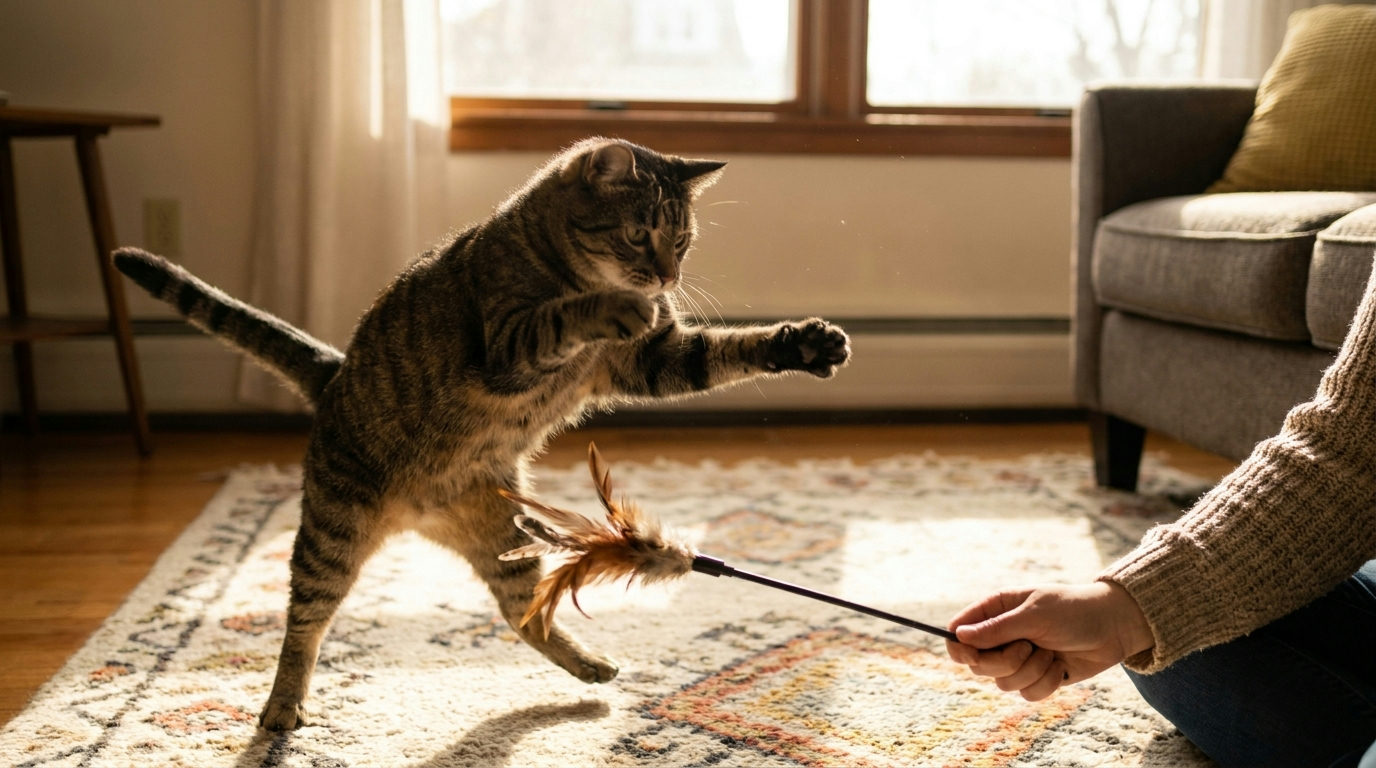
- Chase. Let it dart away in short bursts, changing direction, then pause.
- Pounce and catch. Let your cat actually catch it, often. A toy that can never be caught is frustrating, not fun.
- Wind down. Slow the movements over the last minute so the “prey” tires.
- Eat. Finish with a small meal or a few treats from their daily allowance. That closes the sequence.
That last step is the bit owners miss. It is also a neat way to fit play into the day: play just before you put breakfast or dinner down.
How long and how often
Cats hunt in short bursts, so short sessions suit them. Many cats do well with two or three sessions of around five to fifteen minutes a day, rather than one long one. Young cats usually want more. Older cats may want less but still benefit.
Watch the cat, not the clock. Panting, flopping down or walking away are signs to stop. A cat that is still fixated and twitchy may need a slower wind-down, not more speed.
Choosing toys that earn their place
You do not need a basket of toys. You need a few that let your cat act out the hunt, and the habit of rotating them so they stay interesting.
- Wand toys with a feather or fabric on a string are the most useful single toy, because you control the movement. Put them away after each session so the string cannot be chewed or swallowed.
- Small kick toys let a cat grab and “bunny kick”, which many cats love.
- Puzzle feeders turn part of a meal into a hunt. They are a good fit for cats left alone during the day.
- Balls and crinkle toys for solo play between sessions.
Laser pointers are a special case. Many cats chase them happily, but the “prey” can never be caught. If you use one, end the session by landing the dot on a toy or a treat your cat can actually grab.
Keep string, ribbon, hair ties and elastic bands out of reach between sessions. If swallowed, they can cause serious gut problems that need a vet urgently.
Playing with older, shy or overweight cats
Older cats often still enjoy play, but slower. Keep the toy low and near them, and let them win more often. Stiffness or reluctance to jump can be a sign of joint pain, which is worth raising at the next check-up.
Shy cats may prefer to watch at first. Play at a distance, sitting on the floor, and do not move the toy toward them. Let them come to it.
For cats carrying extra weight, short daily sessions are one of the easier changes to keep up. Pair them with portion control and a plan from your vet rather than relying on play alone.
When play turns into biting your hands
Hands are not toys. If your cat learned to chase fingers as a kitten, it will keep doing it. Use a wand toy to keep distance between your hands and the cat’s teeth, and stop the session calmly if teeth or claws land on skin. No shouting, no punishment. Just stop, wait, and start again later.
Some cats ambush ankles because they are under-stimulated. More structured play, at regular times, often helps more than anything else.
Multi-cat homes
In a home with more than one cat, a confident cat can crowd out a quieter one. Try short one-to-one sessions in separate rooms, or use two wand toys at once. Our guide to enrichment for indoor cats has more ideas for keeping several cats busy.
Frequently asked questions
How much playtime does an indoor cat need?
There is no single figure, but two or three short sessions a day suits many indoor cats. Adjust to your cat’s age, health and energy, and ask your vet if you are unsure.
Why does my cat lose interest in toys so quickly?
Usually the toy is moving like a toy, not like prey, or it has been left out so long it is boring. Slow the movement down, hide it, and rotate toys every few days.
Is it OK to use a laser pointer?
Many cats enjoy it, but they can never catch the dot. End each session on a real toy or treat they can grab.
My older cat will not play at all. Should I worry?
A sudden loss of interest in play can be an early sign of pain or illness, so it is worth mentioning to your vet. If they are well, try slower, shorter play close to where your cat rests.
A routine you can actually keep
Pick two times a day you already have, such as before breakfast and before dinner. Spend five to ten minutes with a wand toy: stalk, chase, catch, wind down, then food. Put the wand away. Swap the toys over at the weekend. It takes ten minutes, and for many cats it is the best part of their day.
Some links on Best Cat Care may be affiliate links. If you buy through them we may earn a commission at no extra cost to you. We only mention product types we would use ourselves.